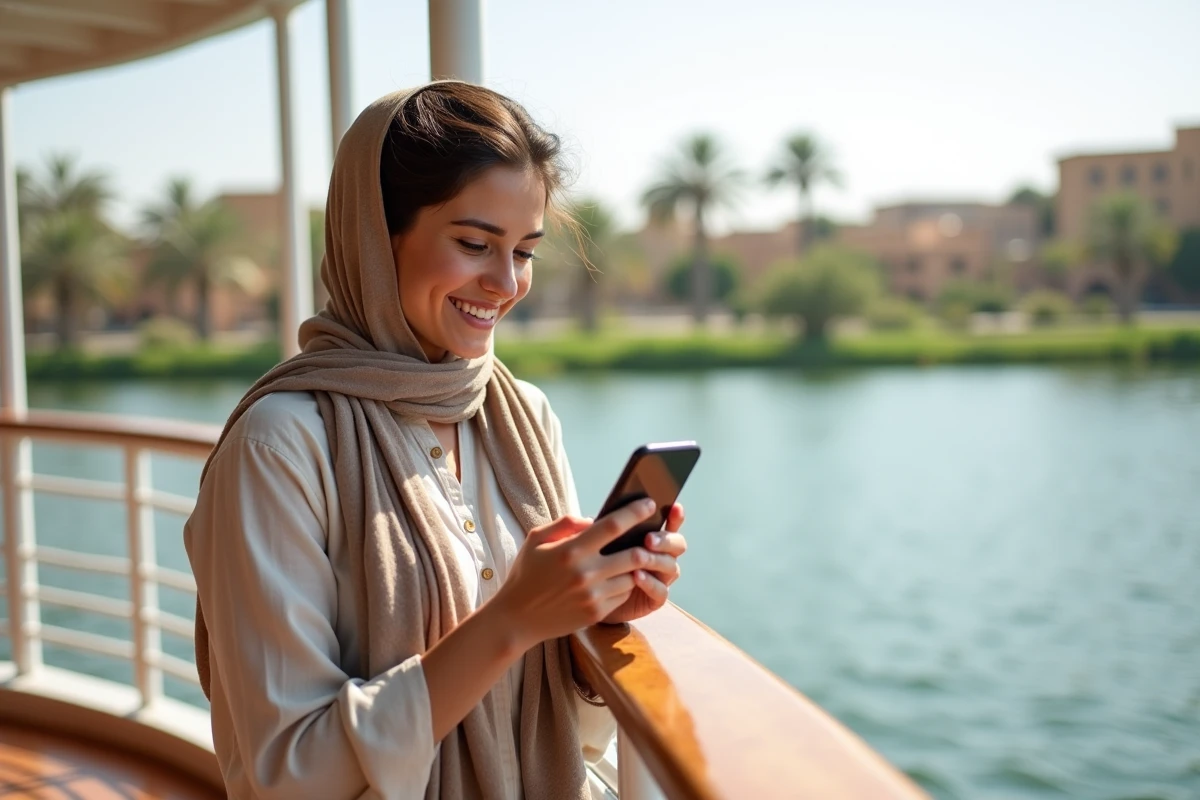
“Unlimited connection”: two words that sound like a universal promise. However, on the Nile, each cruise ship rewrites its own rules of the game. Depending on the company, access can shift from being presented as unrestricted to sudden cuts, sometimes even to packages as narrow as a bottleneck. No standard, no guarantee: the experience varies from ship to ship, and savvy travelers know this well.
In the face of these uncertainties, some operators do not hesitate to charge for access or restrict speed, reducing usage to the bare minimum. The immediate consequence: informed passengers prefer to seek out alternatives, often more reliable than what the ship offers. Goodbye to the promise of flawless connection, hello to organized improvisation.
wifi on the Nile: between tech hopes and on-the-ground frustrations
A trip on the Nile does not deviate from the contemporary rule: staying connected, whether between Luxor and Aswan, becomes almost a reflex. Expectations are high: sharing discoveries, ensuring a video call, or keeping in touch with loved ones. But reality quickly sets in: the onboard wifi depends either on satellites or terrestrial relays, and in all cases, stability leaves much to be desired. Cuts, slowness, total signal loss in some areas: it is impossible to guarantee a uniform experience from one ship to another.
Some high-end units play the card of LEO satellites or brand-new systems and promise superior performance. The terrain, however, imposes its laws: the speed varies sharply, certain stretches of the river become unreachable, and bandwidth struggles to keep up when everyone connects at tea time. To cut through the fantasy and reality, wifi on cruise ships on the Nile deserves a detour through the complete investigation. Here, we discover how much the terrain, remoteness, and traffic weigh heavily in the balance.
To clarify the state of the network according to the type of vessel, here is a summary table:
| Type of boat | wifi technology | Connection quality |
|---|---|---|
| Steam Ship Sudan | LEO Satellite | Variable |
| Dahabiya Queen Tyi | Terrestrial relay | Low to medium |
| Standard boats | No or local hotspot | Often nonexistent |
In the background, the Nile internet connection varies according to the equipment of each cruise line and the travelers’ ability to cope with the unexpected. The verdict is never clear-cut: it all depends on the chosen offer, but also on personal tolerance for digital disconnection. Navigating the wifi market means accepting a share of the unexpected.
what concrete options are there to stay connected during your cruise?
Finding a connection on the Nile requires a bit of anticipation. Beyond the sometimes uncertain wifi onboard, alternative solutions are emerging to cater to different types of travelers. In practice, the local SIM card achieves the best performance for surfing at your own pace. Vodafone, Orange, Etisalat: these major Egyptian operators offer perfectly tailored data plans, valid for almost the entire route between Luxor and Aswan.
The method is simple: once the SIM card or eSIM is purchased at the airport or in a store, activation takes a few minutes, and credit can be easily recharged, sometimes even from the boat. Mobile access often proves to be more effective than the ship’s wifi, which quickly falters as demand rises.
For those who do not wish to bother, some ships sell a wifi package usable only onboard. The service remains limited: emails, instant messaging, social media browsing. It is impossible to stream or organize a stable video conference unless staying on a very well-equipped ship, and few are the lucky ones who truly have access to that.
To clarify the alternatives on the Nile, here are the main options available:
- Local SIM card or eSIM: economical and reliable solution, immediate upon arrival.
- Ship’s wifi package: simple access but crowded, often expensive for limited use.
- Mobile hotspot/4G router: convenient for sharing the connection among several, but be mindful of your data consumption, especially in well-covered areas.
tourist packages, onboard wifi, or local networks: advantages and drawbacks in Egypt
On the river, showcasing convincing onboard wifi is more of a wishful thinking than a promise kept. Companies mention a connection onboard, but the quality rises and falls unpredictably. The ship’s wifi package remains expensive, unstable, and far from unlimited: rapid saturation, fluctuating coverage, slowed speed during peak times. Even with satellite, response times stretch, especially as the boat moves away from cities.
The local SIM card, often better suited to actual usage, offers a regular connection once the phone is compatible and the SIM is activated. With affordable data plans and the freedom to recharge oneself, the user regains control over their internet access during the cruise. However, take the precaution of checking network compatibility and prefer using a VPN, as cybersecurity is not a strong point of Egyptian public networks.
The coverage of the cellular network works perfectly at dock, but the signal can disappear in certain stretches of the Nile. One must accept these offline breaks, inherent to the river adventure. On some luxury boats, the satellite option guarantees a connection even offshore, but it comes with a price that matches expectations. Each of these solutions requires concessions: rugged topography, chosen technology, number of connected users, the equation offers no respite.
Ultimately, navigating the Nile is also about learning to let go. Between two temples, a message gets through, the next photo will wait. What remains is the magic of the river, one that persists with or without a network, far from the tyranny of the wifi bar.